EN
EN

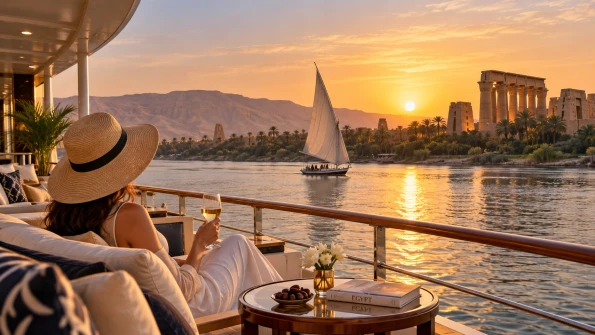
Your Full Guide To The Temples, Tombs, and Natural Beauty Visible From Your Ship on The Nile River
If you've ever dreamed of floating through history while the world's most ancient civilization unfolds along the riverbanks, a Nile cruise is exactly that. But what do you see on a Nile cruise, really?
The short answer: temples, tombs, colossal statues, and landscapes that don't look like anywhere else on earth. Let's walk you through every stop so you know exactly what to expect on a Nile cruise before you set sail.
What Do You See On a Nile Cruise?
The classic Nile cruise follows the golden route between Luxor and Aswan, two cities that together hold some of the ancient monuments ever built.
The Nile river cruise experience is essentially divided into three main stages: land tours to discover ancient artifacts, night entertainment activities, and daily hotel services on board the ship. What you see is not just stone and ruins, it's the story of an entire civilization told across both banks of the river.
1. Temples and Tombs You'll Visit Along the Nile
Every stop along the Nile cruise route has been chosen for a reason and Luxor is the starting point that sets the tone for everything that follows.
Luxor is known by the title the biggest open-air museum in the world, with its archaeological landmarks divided into two banks.
On the East Bank:
Karnak Temple is considered the largest complex religious building ever built, known for its Great Hypostyle Hall which includes 134 colossal columns, showing the development of Egyptian worship over two thousand years.
Luxor Temple is dedicated to the holy Triad of Thebes: Amun, Mut, and Khonsu and is famous for its towering obelisk and the colossal statues of Ramses II at its entrance. A visit is often paired with a night tour to enjoy its magical lighting.
On the West Bank:
The Valley of the Kings served as the royal burial ground for pharaohs of the New Kingdom era, where the remains of several famous royal tombs were found including that of Tutankhamun.
Hatshepsut's Temple at Deir el-Bahari stands out for its unique design and harmony with the surrounding desert landscape, built into the mountain by Queen Hatshepsut herself.
2. Ancient Landmarks Between Luxor and Aswan
As the cruise sails south, the stops along the river are equally remarkable, and each one tells a different chapter of Egypt's story.
- Edfu Temple, one of the most intact ancient Egyptian discoveries, is fully dedicated to the god Horus and is often reached by traditional horse-drawn carriages from the dock.
- Kom Ombo Temple is unique for its dual design: one half dedicated to Sobek, the crocodile god, and the other to Haroeris, the elder Horus. It also includes a small museum displaying mummified crocodiles.
Between temples, the Esna Lock is a key crossing point for all Nile River cruises, a barrier that controls the water level. Tourists typically watch the fascinating process of the ship moving from a lower level to a higher one directly from the deck.
3. Must-See Stops on Every Nile Itinerary
When your cruise arrives in Aswan, a new chapter begins, one where ancient pharaonic monuments meet Nubian culture and natural beauty.
- Philae Temple, considered the jewel of Nubia, was entirely relocated to Agilkia Island to protect it following the construction of the High Dam, and is visited via a short riverboat journey.
- The High Dam is one of the most important engineering projects in twentieth-century Egypt, and offers visitors a sweeping view of Lake Nasser.
- The Unfinished Obelisk, located in the ancient granite quarries, provides a rare opportunity to understand exactly how the ancient Egyptians cut and carved their colossal monuments.
For those who want to go beyond the standard itinerary, optional tours typically include Abu Simbel Temples, an additional air or land trip to see the breathtaking Nubian reliefs carved directly into the rock face as well as a visit to the peaceful Botanical Garden Island.
4. Iconic Sites That Define a Nile River Journey
What makes a Nile cruise unlike any other travel experience is not just the individual monuments, it's the way they connect. You see history unfold in sequence. You sail from one era to the next, watching the landscape shift from lush green riverbanks to golden desert cliffs, passing small Nubian villages where daily life looks much as it has for centuries.
Along the route, expect beautiful views of the river banks with their rising sand dunes, lush greenery, and scenes of local village life by the water. By night, the top deck offers unspoiled views of the starry night sky, one of the most memorable moments on the entire journey.
5. From Pharaohs to Pyramids: Sights That Make the Trip
What do you see on a Nile cruise in terms of sheer variety? More than most people expect. In just a few days, you move between:
- The grandest religious complex ever built (Karnak Temple)
- The tomb of the boy king (Valley of the Kings)
- A temple rescued from rising floodwaters (Philae Temple)
- A dual-deity sanctuary unlike any other (Kom Ombo Temple)
- A monument to modern Egyptian engineering (the High Dam)
- A rock-carved wonder that had to be moved to survive (Abu Simbel)
Each of these sites carries thousands of years of history and on a Nile cruise, you reach all of them with expert guides, without the stress of organizing transport between cities yourself.
Explore Egypt with Egypt Nile Trip
If you're ready to experience everything a Nile cruise has to offer from the temples of Luxor to the Nubian shores of Aswan, Egypt Nile Trip is your trusted partner for the journey.
We specialize in curating Nile cruise experiences that balance ancient discovery with genuine comfort.
From the moment you board to your final glimpse of the Nile from the top deck, every detail is handled so you can be fully present for every sight, every story, and every unforgettable moment.
Whether you're traveling as a couple, a family, or a group of adventurers, our team is here to make your Egyptian journey seamless, enriching, and truly memorable.
Conclusion
So, what do you see on a Nile cruise? You see temples that have stood for over three thousand years. You see the tombs of pharaohs. You see the Nile itself, ever-present and timeless, carrying you from one wonder to the next.
And you see it all from the comfort of a floating hotel where the scenery is always changing and the history never stops. With Egypt Nile Trip, every moment of it is taken care of. Book with us now.
Frequently Asked Questions
01What Do You See on a Nile Cruise Between Luxor and Aswan?
The classic Nile cruise route includes Karnak Temple, Luxor Temple, the Valley of the Kings, Hatshepsut's Temple, Edfu Temple, Kom Ombo Temple, Philae Temple, the High Dam, and the Unfinished Obelisk, with optional excursions to Abu Simbel.
02What To Expect on a Nile Cruise in Terms of Daily Schedule?
Days are divided between guided shore excursions to ancient temples and monuments, and relaxed time on board enjoying meals and onboard facilities.
03How Many Days Is a Typical Nile Cruise?
Most Nile cruises run for 3 to 4 days, covering the route between Luxor and Aswan.
04Is a Nile Cruise Suitable For All Ages?
Absolutely. Nile cruises are a comfortable, well-organized way to explore Egypt that suits families, couples, solo travelers, and seniors alike.